budgets · September 1, 2026
Reading a Budget Line Like a Suspect
One line in a city budget can tell you more than the speech that introduced it. How we read a single row of a fictional budget, and what the dull columns give away.
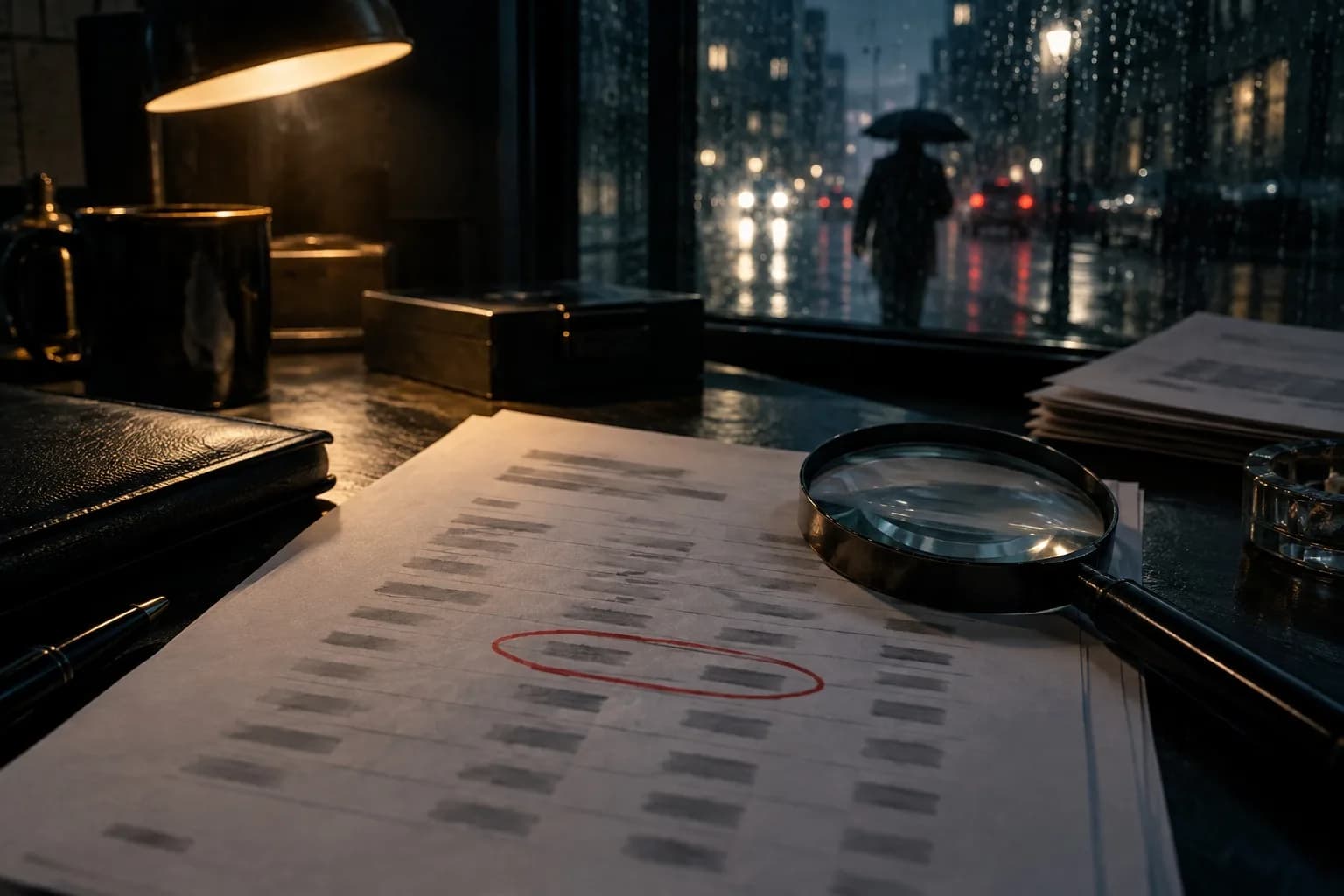
Nobody reads a municipal budget for pleasure. It runs to four hundred pages, the numbers are set in a grey that's hard on the eyes, and the speech that introduces it was written to make you stop reading. That's why it's useful. Everything a city is embarrassed to say out loud has to go somewhere, and it goes in a row.
Here is one row from the Marrowgate Capital Plan. All figures are invented, but the habits are real.
4410 · Harbourside Contingency · 1,840,000
Three things to ask, in this order.
What does the code say?
The four-digit number is the account. Accounts are grouped by hundreds, and 4400 to 4499 is the block for infrastructure reserves. So this money lives with roads and drains, not with planning or the waterfront office. That is odd. A contingency named for a rezoned district ought to sit near the people who rezoned it.
Whoever put it in this block either wanted it to look dull or wanted it somewhere a different committee would sign it off. Neither is proof. Both are questions.
What did it cost last year?
A budget gives you the prior year beside the new one, and the gap between the two is the closest thing to a confession you will find in public paper. In the previous plan, row 4410 held 210,000. This year it holds 1,840,000. That is a rise of roughly 776 percent, and nobody in the introductory speech used the word.
Check the arithmetic yourself: 1,840,000 minus 210,000 is 1,630,000, and 1,630,000 divided by 210,000 is about 7.76. A jump that size either follows a decision or precedes one. Look for the meeting where it was decided. If the minutes of that meeting are the ones that are missing, you may have found your story. (We may have.)
What does the footnote explain?
The footnote on this row reads: "Provision for unforeseen requirements associated with the Harbourside area." It sounds like an answer. Read it twice and it's a very long way of saying nothing.
A real footnote has a noun in it. It names a project, a contractor, a legal case, a date. This one has a district and a mood. "Unforeseen" is the word to underline, because a contingency is by definition money for things nobody has yet seen, and it can be spent on a thing nobody ever has to explain.
What you do with it
You don't print a theory. You write down three questions and take them to the finance office with a copy of the page. You ask who proposed the number, which committee approved it, and what has been drawn against it so far. A contingency with no draw-downs is a savings account. A contingency with a draw-down is a ledger, and ledgers have dates.
The speech is for the cameras. The row is for the record.
Names, places and events in this demo are fictional.
No comments yet
Comments are open. Have a thought or a question? Share it below.